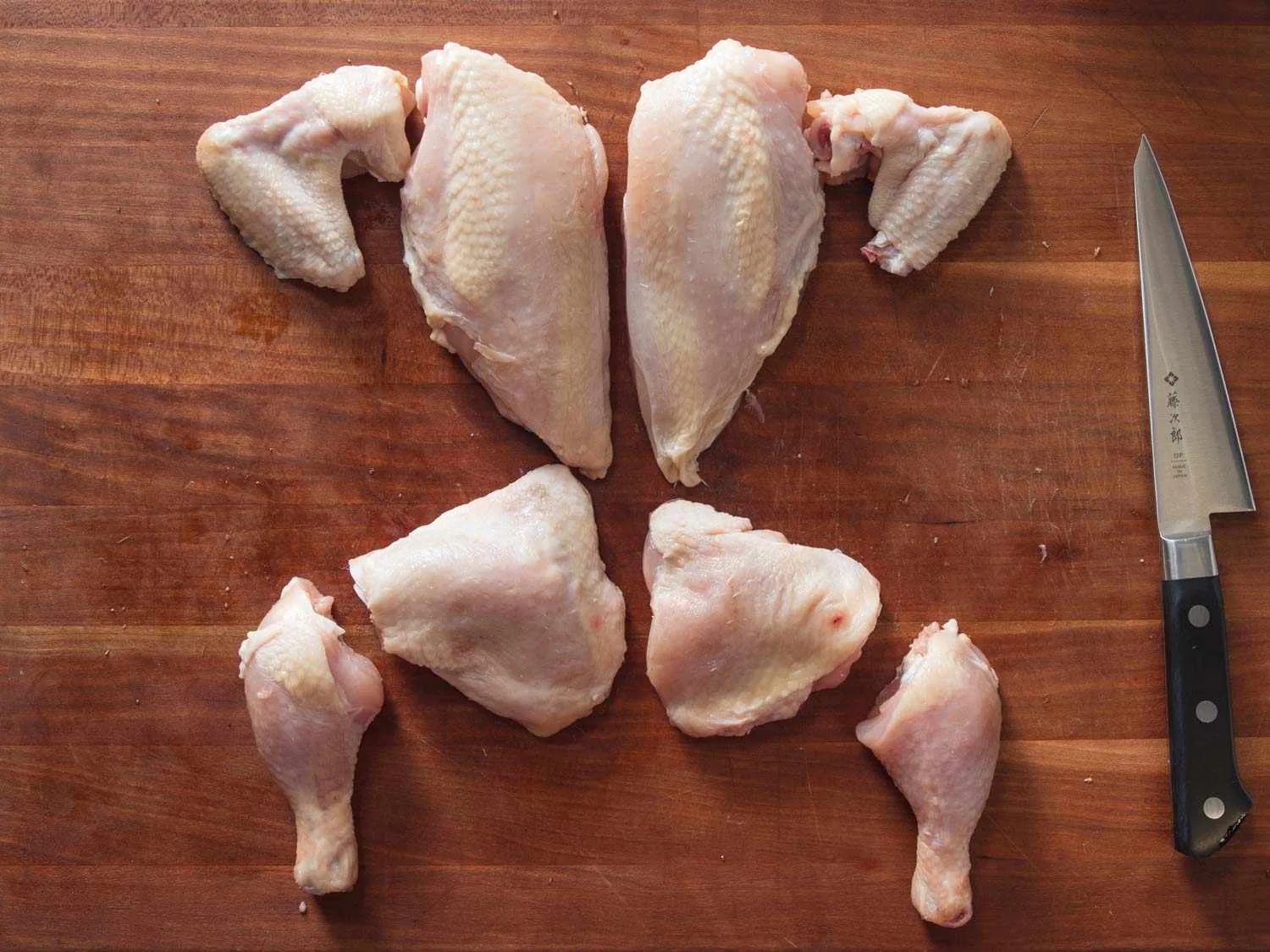
Every cut, and what it is actually for
Most chicken buying arguments come down to a word nobody defined. Here is every cut we sell, roughly what it weighs, what it is genuinely good for, and where it sits on the bird.
12
Cuts & parts
65–72%
Usable yield
1.2–1.8kg
Dressed bird
15–20%
Deboning loss
Every cut, explained
Weights are typical averages on our birds, not guarantees. Every bird is not the same, and the right way to use this table is as a planning reference — then tell us your target weight and we will aim for it.
| Cut | Typical weight | Best for | Notes |
|---|---|---|---|
| Whole broiler | 1.2 – 1.8 kg | Roasting, boiling, butchery for a full family | Ask for it dressed, or whole uncleaned if you are breaking it down yourself. |
| Breast fillet (boneless, skinless) | ~180 – 220 g | Frying, grilling, slicing, meal prep | The premium cut. Most restaurants buy this one. |
| Breast half (bone-in) | ~250 – 300 g | Roasting, baking,-plate service | Keeps more moisture than a fillet. Good value per kilo. |
| Whole breast (bone-in) | ~350 – 420 g | Roasting, carving, sandwiches | One piece, feeds two to three people. |
| Boneless thigh | ~95 – 120 g | Curries, stews, slow cooking, grilling | Our most forgiving cut. Hard to overcook. |
| Thigh (bone-in) | ~110 – 130 g | Roasting, grilling, braising | Flavour plus a little more fat than breast. |
| Drumstick | ~95 – 115 g | Roasting, frying, kids’ menus | Popular in fried and BBQ formats. |
| Leg quarter | ~200 – 240 g | Rotisserie, grilling, single-serve menus | Thigh plus drumstick still attached. |
| Wing | ~90 – 110 g | Wing night, buffalo, BBQ glaze | Ask for flats, drumettes, or mixed. |
| Gizzets, hearts, livers | By the kg | Pate, gravies, gizzard stew, pet-grade | Available on request. Tell us which you want. |
| Car, back and neck | By request | Stock, broth, pet food | Full-flock option. Often free with bulk orders. |
| Skin and trim | By request | Stock rendering, rendering fat | Useful if you run a kitchen that makes its own stock. |
Pick your method
If you are choosing for a kitchen rather than a supermarket shelf, start here. Dry-heat methods and moist-heat methods want different cuts, and picking correctly saves you trimming later.
Hot and fast
High heat, short time. You need even thickness or it cooks unevenly.
Breast fillet, strips, drumsticks
Slow and moist
Long, forgiving cooking. These cuts only improve the longer they go.
Thigh, leg quarter, whole bird
Curry and stew
Wants to hold flavour through a long simmer, and stays tender.
Boneless thigh, leg quarter
Portion control
You need a consistent piece per serving, in the kitchen, not on paper.
Whole-muscle portions, leg quarters
Do the arithmetic
This is where a quote goes wrong. If you are planning a menu or pricing a dish, you need yield, not just price per kilo.
- A dressed broiler gives roughly 65–72% usable meat once bone, skin and trim are removed.
- Moving from bone-in to boneless portions costs a further 15–20%, mostly bone and skin.
- A whole 1.5 kg dressed bird usually yields around 1.0–1.1 kg of edible meat before further trimming.
- If you spec a 110 g drumstick, the bird needs to be the right size for it. Over-order birds and you end up paying for weight you trim away.
How to order well
Name the cut, not the bird
“Ten kilos of boneless thigh at 110 g, skin off” is a spec we can price and pack. “Chicken” is a conversation we have to have first.
Set a weight range
Give us a target and a tolerance, for example 100–120 g. We will aim for it, and you get pieces close enough to portion consistently.
Say what you do with it
Menu, freezer, butchery counter or factory line. The use changes what we recommend, and it is free to ask.
If you would rather learn the reasoning behind all of this before you order, start with what you need to know about chicken meat or read how the birds are processed on site.
Answered
What is a whole broiler average weight?
What yield should I expect from a whole bird?
Do you debone chicken?
Can I get skin removed?
Are giblets included?
Can you mix cuts in one order?
More on chicken meat
Chicken meat products
The full range we sell, from whole broilers to vacuum-packed portions.
Read more →Chicken meat processing
What happens between the farm and your delivery, and how to spec cuts that fit your kitchen.
Read more →Chicken meat delivery
Coverage, order cut-offs, refrigerated fleet and how to set up a standing weekly drop.
Read more →What you need to know
Grades, weights, yield, what fresh actually looks like, and how to order with confidence.
Read more →How to prepare chicken meat
Safe prep, internal temperatures by cut, and cooking times that match the clock.
Read more →Chicken nutrition facts
Protein, calories and fat per cut, and how to buy for a high-protein kitchen.
Read more →Fresh chicken & food safety
Cold chain, storage temperatures, shelf life and safe handling from delivery to plate.
Read more →Wholesale chicken supply
Standing orders, minimums, delivery schedules and cold room capacity for Kigali businesses.
Read more →Not sure which cut your menu needs?
Tell us what you cook and how many covers you serve. We will tell you which cuts fit, in what ratio, and what it costs per kilo. No upsell.
+250 788 309 077
Poultry supply
+250 788 867 296
Wholesale orders
Email us
Rusororo
Gasabo, Kigali